
Condoleezza Rice Unwisely Cheers on Trump’s War in Iran
Rice’s advocacy for preventative war and regime change in Iran echo the same mistakes she made on Iraq.

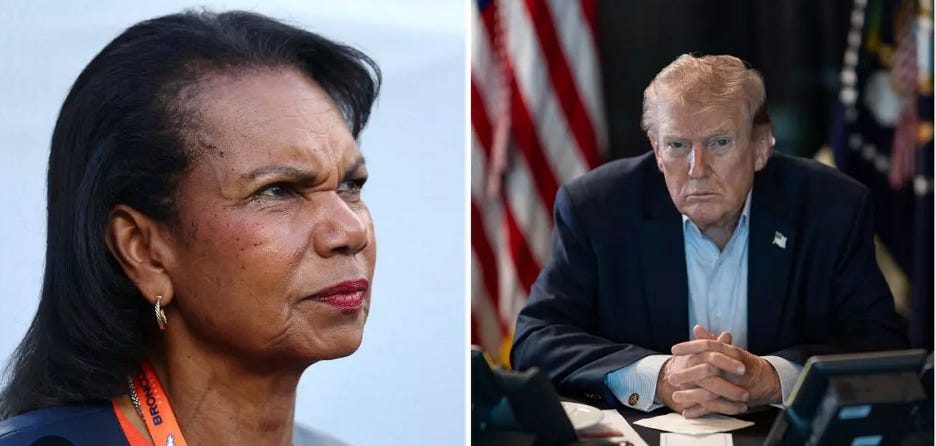
Former Secretary of State Condoleezza Rice’s commentary in Thursday’s Wall Street Journal lauding the Trump administration’s Iran war is a stark reminder of why the U.S. national security establishment has lost so much credibility in the eyes of the American people over the past quarter century. Predicting that the war will “produce a far better Middle East” and that “with a little more time” Trump can build a “different and more stable region” seems like déjà vu all over again, as if Rice learned absolutely nothing from the misadventure in Iraq. No wonder the American public is so much warier of international engagement and skeptical of the national security establishment than it was 25 years ago when Rice’s boss, President George W. Bush, took office.
Let’s start with Rice’s assessment that the Iran war has been beneficial because it has weakened Iran’s military capabilities, set back Iran’s nuclear ambitions, and brought the United States, Israel, and the Gulf Arab states closer together.
Even if all these things were true, it is striking that Rice’s analysis is devoid of any consideration of the cost of this war or whether these policy objectives could have been achieved more effectively through nonmilitary means.
The costs have been substantial. The air war has caused over 7,000 deaths and 42,000 casualties in the region, with 13 American servicemembers killed and almost 400 wounded. At least 1.3 million Lebanese, about 20 percent of the country, have been displaced from their homes. The OECD estimates that the global economy has contracted by $100 billion due to the war, but that could rise to $800 billion in lost growth if oil disruptions continue through the end of this year. American consumers alone have paid an extra $60 billion in fuel costs since the conflict began. The potential global consequences are even more severe. Rising fertilizer prices from the closure of the Straits of Hormuz could lead to food security crises in Africa and South Asia and shortages of sulfur and helium could lead to a sharp reduction in production of electric batteries and semiconductors.
Most people look at these costs and the paltry accomplishments of the Iran war and reach the opposite conclusion from Rice—it hasn’t been worth it.
Moreover, we will never know if the most important of the supposed benefits of the war— the degradation of Iran’s nuclear capabilities—could have been achieved without warfare because the United States and Israel launched their air war in March while nuclear talks between the United States and Iran were ongoing. The air war was initiated even though substantial bombings of Iran’s nuclear facilities in June by Israel and the U.S. had already buried much of Iran’s enriched uranium stockpile and mitigated concern that Iran was close to reaching a nuclear threshold. Those attacks, as well as the U.S.’s capture and arrest of Maduro in Venezuela, demonstrated to Iran that it faced a credible threat of force if it did not agree to dismantle its nuclear program. But the rash turn to war eliminated any possibility of knowing whether, in this new environment, the coercive diplomacy with Iran might have borne fruit.
The echoes of Iraq are unmistakable. Rice insists that the war in Iraq was “worth it,” but she wildly overestimates what has been achieved in Iraq, with Freedom House still rating the country as “Not Free,” its politics still influenced by Iran, and its economy in 2023 performing at about the same level as prior to the U.S. invasion, representing two decades of essentially zero economic growth. The costs of this war: 275,000 direct deaths (including 185,000 Iraqi civilians and 4,598 U.S. servicemembers), countless indirect deaths from the collapse of the Iraqi health care system, economic degradation, environmental contamination, and trauma, 32,000 injured American servicemembers, and budgetary costs to the American taxpayer of $2.9 trillion (which includes an estimated $1.1 trillion to provide medical services and disability benefits to wounded Iraq War veterans until 2050).
And like the Iran war, we will never know whether these horrific costs of war could have been avoided if the U.S. had agreed to the enhanced weapons inspections the United Nations was ready to implement in the fall of 2002. Bush and Rice, however, were determined to go to war to remove Saddam Hussein from power; the rest, as they say, is history.
Furthermore, despite how badly the Bush/Rice regime change war in Iraq turned out, Rice remarkably suggests in her op-ed that regime change was a laudable goal for Trump’s war against Iran. Everyone, especially those in Iran, would like to see the Islamic Republic replaced. But how many examples of failed American-led regime change wars do we need to experience to convince Rice and other national security experts that Western-backed regime change in the Middle East doesn’t work? Aren’t Iraq, Afghanistan, and Libya enough?
The only recent Middle East regime-change effort that appears to have worked out has been in Syria, where the new government is far from perfect, but it has rejoined the international community and taken positive steps to stabilize the country. Perhaps the new government’s tentative success stems from the fact that it achieved power without any help from the widely distrusted West. Suspicion of western-influenced regime change would be doubly intense in Iran, whose people deserve better governance, but will certainly not be amenable to new rulers hand-picked by the U.S. and Israel.
It is also stunning to read Rice scolding our European allies for insufficient concern about the Iranian nuclear threat and failure to support the American regime change war. In making this charge, Rice ignores that the United States, Europe, and indeed, the entire international community were on the same page about how to address that threat when the Obama nuclear deal (JCPOA) was approved unanimously by the UN Security Council in 2015. Had Trump not unilaterally ripped up that agreement in 2018, none of Iran’s recent nuclear advancements would have occurred and it would have a far smaller stockpile of enriched uraniumtoday. Of course, Europe should work with the United States to address the reality of the Iranian nuclear threat, but it is ludicrous to suggest that Europe is obliged to join Trump’s war of choice primarily designed to bring about regime change.
Rice is also advocating bizarre negotiating tactics, suggesting to the Trump team that Iran should not receive “a penny” of frozen assets or sanctions relief for making nuclear concessions. But Trump already tried to get Iran to capitulate to all his demands without making any concessions through the 39-day bombing campaign and Iran refused to fold. Why does Rice think Iran will fully capitulate now, without any sanctions relief, when it is abundantly clear that Trump has no interest in restarting the air war and Iran has demonstrated it can weaponize the Straits of Hormuz?
Rice’s call for “strategic patience” regarding the conflict in the Gulf shows how deeply out of touch she is with the current desires of the American public. While preventing Iran from obtaining a nuclear weapon is a broadly shared goal, the public opposes deep engagement in the intractable rivalries of the Middle East, which when they flare up, cause large-scale economic dislocation across the globe and taint the United States with the widespread human suffering that violence and conflict in the region causes. Doubling down on the Middle East after a quarter century of involvement has produced virtually nothing of value to the American public only heightens its skepticism about international engagement. If we want the American public to support international engagement and American global leadership, Rice’s stale playbook advocating U.S. Middle East interventionism and regime change is not the way to go.
Iran’s nuclear ambitions were already hemmed in by the agreement forged by the Obama administration Trump tore up the agreement, not because it wasn’t working, but because of his deep jealousy of Obama and his many accomplishments. Of course, Trump was cheered on by the Condoleeza Rice wing of the Republican Party in abrogating the agreement because, to them, war and bombing are always a superior solution. Now we are left with the smoldering remains of Trump’s idiotic decision. More bombing will not dislodge the chokehold that Iran has over the Straight. Sending in troops to be sitting ducks to Iran’s drone weaponry is a bridge too far, even for Trump. Negotiations are failing because Trump is unable to capitulate to Iran’s demands for security and Iran is understandably unable to trust anything that Trump says, given his shifting by the hour pronouncements. So the Straight remains closed while Trump continues to draw down our safety supply of petroleum and the Republicans pretend that the current stasis is not the ongoing disaster it really is. The one lesson that other countries around the world have learned from this-we need a nuclear weapon to deter the United States from attacking us. So Congratulations Condoleeza and the all the chicken hawks you carry water for. The end result of your “strategy “ is an emboldened Iran with strategic power it is consolidating by the day, and the seeds of nuclear proliferation around the world